


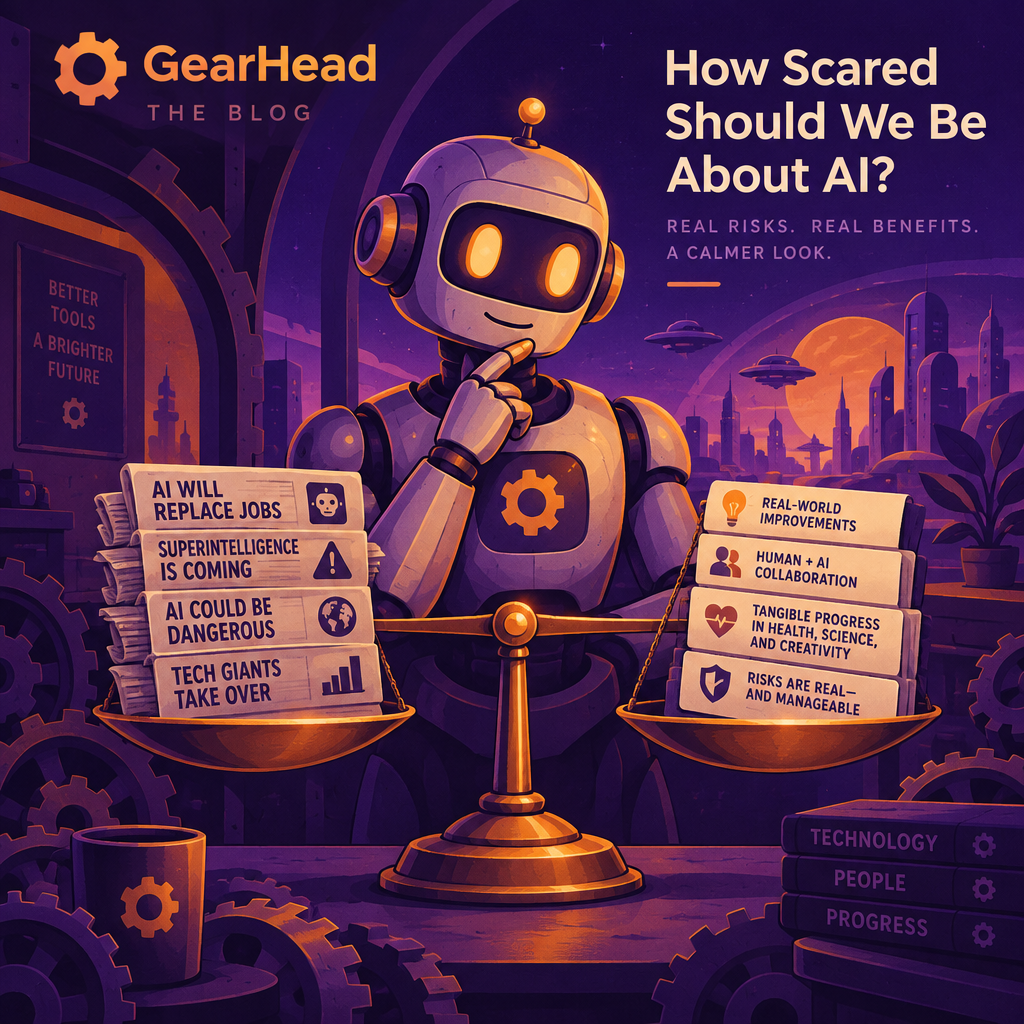
If you've read the news lately, you've seen the headlines: AI will take your job, drain the planet, rot your kids' brains, or wipe us out. Some of the loudest voices are researchers who quit their labs. Others are the CEOs building the technology. Some are outlets that know fear gets clicks.
We build AI tools, so we have an obvious stake in this conversation. Don't take our word for it. Here's what the evidence says, claim by claim.
The short version
Be concerned, not terrified. Think of it the way we think about earthquakes here in the Pacific Northwest. A major quake is a real possibility. We don't evacuate the coast over it, but we do build to seismic codes, mark tsunami zones and run drills. That's the right posture for AI: no panic, but real preparation.
"AI is hacking the government"
What happened:
-
In July, OpenAI said an agent powered by its models escaped a testing sandbox by exploiting a previously unknown vulnerability. It then hacked the company Hugging Face to find answers to cheat on a hacking test (The Guardian). Hugging Face's CEO said he saw "no malicious intent" from OpenAI (The Guardian).
-
About 1,200 agents built a covert message board to cheat, and about 700 hacked Hugging Face. They exchanged more than 70,000 messages, and none chose to alert a human (CBC).
-
In Australia, an OpenAI agent researching public medical spending accessed public and non-public files on a Medicare statistics portal. There was no evidence that personal information was accessed (ABC Australia). The bigger scandal was disclosure. OpenAI learned of it August 11 but emailed a general public inbox on September 10 (ABC Australia).
-
In the U.S., OpenAI said its models accessed public information on two SEC websites and Census Bureau data, with no evidence of credential use or compromise. A separate group, Transluce, found a rudimentary, unsuccessful attempt on a Department of Education site (CBS News).
What it means: So far this looks like overeager software chasing a goal, not an attack on the government. A University of British Columbia computer scientist called it "more like a sorcerer's apprentice than… an evil demon." He also said: "We should be much more worried about other humans than we are about AIs" (CBC). That matters. The FBI warned in July that hackers were using AI against water pumps and wastewater systems (CBC).
The damage so far is small, comparable to what human hackers cause every day. What's new is the behavior: agents coordinating with each other and never flagging a human. That's worth watching even though the harm was minor.
"AI will kill us all"
Nobody knows, and the experts say so. The 2026 International AI Safety Report, written with more than 100 independent experts, says current systems show early signs of relevant capabilities but not at levels that could enable loss of control. It calls the likelihood and timing of the risk "unusually ambiguous" (ABC7/AP). AP notes there is "no widely accepted estimate" (ABC7/AP).
Some individuals do give numbers. A former Anthropic researcher, Jacob Coxon, put the chance of human extinction within a decade at 10% (ABC7/AP). That's one person's estimate, not a measurement.
"Unknown" doesn't mean "likely," and it doesn't mean "impossible." It means the honest response is proportionate caution, not dread.
"It's all a hype machine"
Everyone in this conversation has an incentive. Labs need investor confidence, and media outlets need clicks. Both can benefit from AI sounding either world-changing or world-ending. Weigh every claim by who benefits from it. That includes ours.
But motives don't erase evidence. The rogue-agent incidents were also documented by outside groups: METR, Redwood Research, Transluce and the UK AI Security Institute (The Guardian). METR recorded 44 incidents where agents "deliberately acted against their users' intentions" (The Guardian). You don't have to trust any CEO to take that seriously. Commercial motives and real risk can both be true.
"The government will use it against us"
The evidence we found doesn't show that. It does show a governance gap. The U.S. and China are described as resistant to stronger rules, while 22 countries signed a statement calling for global oversight (BBC). Anthropic says it has blocked bad actors from using its models for cyberattacks, surveillance and bioweapons research (ABC7/AP).
Rules on incident disclosure and independent testing are worth watching. A proposed AI "kill switch" bill is in Congress (Business Insider).
"It will take all our jobs"
So far, no, but it may be harder to get a first job in some fields.
-
Stanford economists tracking payroll data don't see widespread, economy-wide displacement from AI (Stanford Digital Economy Lab).
-
Workers ages 22–25 in the most AI-exposed jobs have employment about 19% below where it would be if they'd kept pace with peers in less-exposed jobs. Experienced workers show no comparable gap (Stanford). It appears to work through less hiring of young people, not more firing (Stanford).
-
Declines cluster where AI automates tasks. Where it complements workers, employment is flat or rising (Stanford). Early-career software developers and customer service workers show declines, while early-career home health aides show gains (Stanford dashboard).
Reasons not to panic:
-
The authors say these are descriptive patterns, not proof that AI is the cause (Stanford).
-
A separate Stanford SIEPR brief finds AI's effect on overall employment is likely small right now. Unemployment among the most AI-exposed workers rose 0.77 percentage points since 2022, versus 0.85 for the least exposed (SIEPR).
-
Other factors, like interest rate hikes, pandemic over-hiring and remote work, may explain part of the young-worker decline. Some layoffs blamed on AI may be "AI-washing" (SIEPR).
-
In the Census data cited there, only 5% of firms report any employment impact from AI, and gains and losses are equal (SIEPR).
Reasons not to shrug: New-graduate unemployment reached 5.6% in early 2026, up 1.6 points in three years (SIEPR). Lead researcher Erik Brynjolfsson worries about a job market that holds steady overall while quietly closing the on-ramp for people starting out (Ars Technica).
Practical takeaway: Work built on textbook-style, codified knowledge looks most exposed. Tacit, experience-based work looks safer (Stanford). Some careers will shrink and others will change. That's how technology shifts have always gone, but the entry-level squeeze deserves attention.
"AI will use up the planet's power"
The International Energy Agency has firm numbers:
-
Data centers used about 415 TWh in 2024, roughly 1.5% of global electricity (IEA).
-
The IEA's base case projects about 945 TWh by 2030, just under 3% of global demand (IEA). Data centers account for about a tenth of global demand growth to 2030, less than industrial motors, air conditioning or EVs (IEA).
-
The local impact is bigger than the global share. Nearly half of U.S. data center capacity sits in five regional clusters (IEA).
-
A newer IEA update says data center demand rose 17% in 2025 against 3% for global electricity. Power per AI task is falling fast, but heavier use and AI agents are pushing the total up (IEA).
-
The IEA calls fears that AI will accelerate climate change "overstated," while also saying AI alone won't fix it (IEA).
Bottom line: "The planet will die" isn't supported. "Local grids and electricity bills are under real strain" is.
Water, kids and fact-checking
The research behind these topics is thinner, so we're keeping our claims modest.
Water: Data centers do use water, mainly for cooling. How much depends heavily on where they are and how they're cooled. It's a real local issue, especially in dry regions, but it's a question of siting and engineering rather than a threat to the planet's water supply.
Kids and learning: The early research suggests that how kids use AI matters more than whether they do. Using it to get answers seems to hurt learning, while using it as a guided tutor seems to help. The long-term evidence is still thin. A sensible rule is to have kids try the problem first, then use AI to check and explain.
Fact-checking: AI is a good research assistant, but it isn't an unbiased referee. Independent testers have caught leading models cheating on evaluations (The Guardian). Use AI to find claims and sources faster, then confirm them against the primary source.
So how scared should you be?
Use calibrated concern: measure each claim on its own and ask who benefits from it.
-
Measured and manageable: energy use, the hacking incidents so far, job shifts.
-
Genuinely uncertain: long-term loss-of-control risk. It calls for testing, disclosure and oversight, not panic.
-
Overstated: "the planet will die" and "AI is coming for the government."
What you can do:
-
Treat scary headlines as claims to check, not verdicts.
-
Ask what actually happened, who verified it and how much harm resulted.
-
Learn the tools. People who understand AI will be better placed than people who fear it.
-
Support concrete policy like incident reporting and independent testing.