


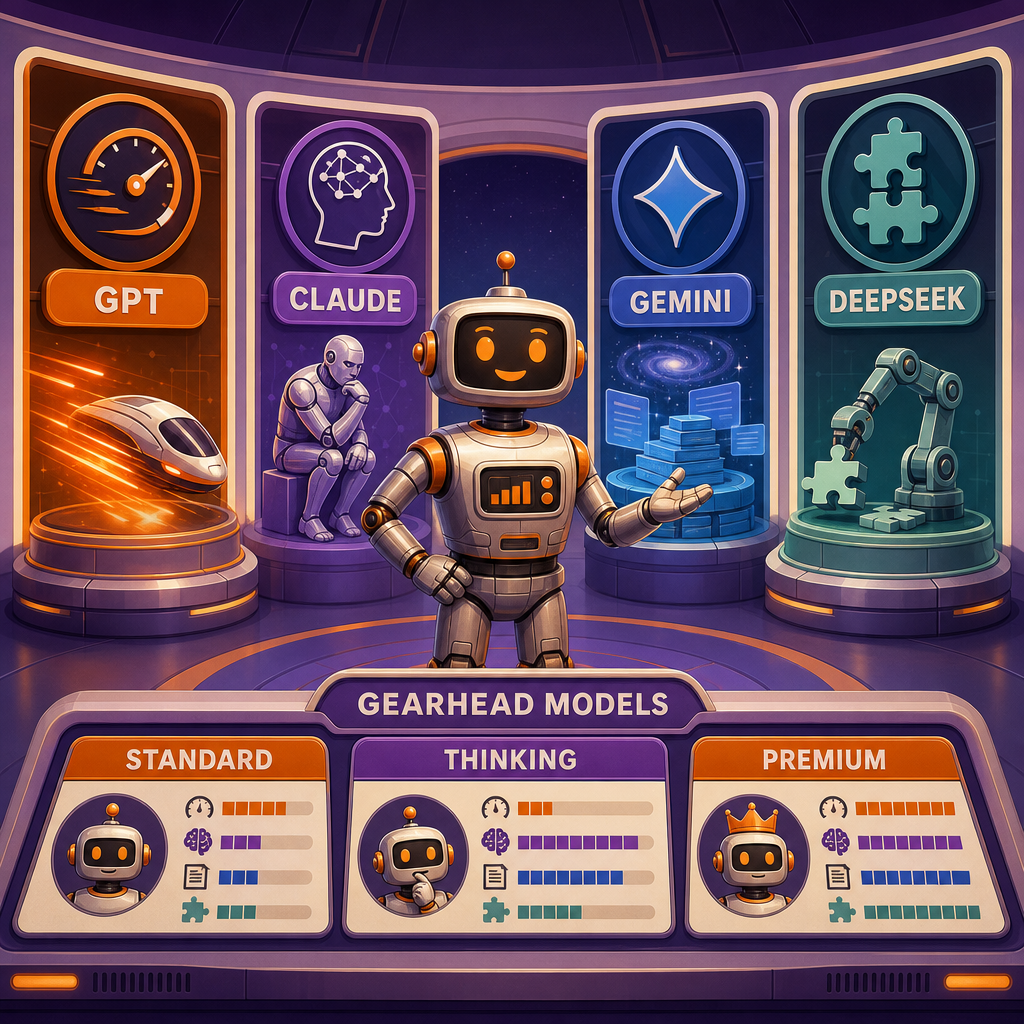
AI models can feel confusing fast.
There’s GPT, Claude, Gemini, and DeepSeek. Then there are model names like Luna, Terra, Sonnet, Flash, Pro, Opus, and Fable.
What do all those names mean?
The simple answer is this:
Different AI models are like different specialists on the same team. Some are better at writing. Some are better at research. Some are better at solving difficult problems. Some are designed to work quickly and inexpensively.
Inside GearHead, you don’t need to memorize every technical detail. You just need to understand which kind of model fits the job in front of you.
The Four Major AI Families (Frontier Models)
GPT: The versatile all-rounder
GPT models are built to handle a wide range of everyday tasks. They’re useful for brainstorming, drafting emails, explaining ideas, working through business problems, and helping with many different types of workflows.
Think of GPT as the person on your team who can jump into almost any meeting and contribute.
Use GPT when you want to:
-
Brainstorm ideas
-
Draft or rewrite content
-
Work through business decisions
-
Get a fast, well-rounded answer
-
Handle a task that mixes writing, reasoning, and general problem-solving
Inside GearHead, GPT Luna is designed for fast, everyday work, while GPT Terra and GPT Sol Max are built for increasingly difficult problems.
Claude: The careful writer and thoughtful analyst
Claude is especially strong when the quality of the writing, reasoning, and overall judgment matters.
It tends to be a good fit for long-form articles, proposals, strategy documents, code review, editing, and work where you want the answer to feel thoughtful instead of rushed.
Think of Claude as the careful editor, architect, or senior consultant on your team.
Use Claude when you want to:
-
Write a polished blog article
-
Improve tone and clarity
-
Analyze a complicated document
-
Review code or technical plans
-
Maintain a consistent voice across a long piece of writing
-
Think through a nuanced decision
Sonnet is the practical everyday Claude model. Sonnet Thinking is designed to spend more effort on difficult problems. Opus and Fable are premium options for work where depth and quality matter more than speed or cost.
Gemini: The researcher and large-context specialist
Gemini is useful when you’re working with a lot of information or multiple types of media, such as documents, images, charts, and other visual material.
Think of Gemini as the researcher who can spread a huge pile of documents across a conference table and look for patterns.
Use Gemini when you want to:
-
Analyze long documents
-
Compare multiple files
-
Work with images, charts, or visual information
-
Summarize a large amount of material
-
Research a broad topic
-
Find connections across a large amount of context
Gemini Flash is the fast, efficient option. Gemini Pro is the deeper-thinking option for more complicated research and analysis.
DeepSeek: The efficient problem-solver
DeepSeek is known for providing strong reasoning and technical results at a lower cost, which makes it useful for high-volume work and structured problem-solving.
Think of DeepSeek as the resourceful engineer who can handle a large stack of clearly defined tasks without needing the most expensive equipment in the shop.
Use DeepSeek when you want to:
-
Process many similar tasks
-
Generate or analyze structured content
-
Work through logic-heavy problems
-
Create drafts that will receive human review
-
Keep processing costs lower
-
Handle repetitive or high-volume work
DeepSeek’s standard model is a good fit for efficient everyday tasks. DeepSeek Pro is designed for more demanding reasoning.
The Three Model Tiers Inside GearHead
The model family tells you what kind of specialist you’re using.
The model tier tells you how much effort and processing power you want to spend on the task.
Standard models: Fast and practical
Standard models are designed for speed and everyday usefulness.
Examples include:
-
Claude Sonnet
-
Gemini Flash
-
GPT Luna
-
Standard DeepSeek
Use a standard model when:
-
You need a quick answer
-
The task is fairly straightforward
-
You’re drafting, rewriting, summarizing, or brainstorming
-
You’re working through several small tasks
-
A perfect answer isn’t worth waiting longer for
For most everyday GearHead conversations, a standard model is the right place to start.
Thinking models: The working horses
Thinking models spend more time examining the problem before answering.
Examples include:
-
GPT Terra
-
DeepSeek Pro
-
Claude Sonnet Thinking
-
Gemini Pro
Use a thinking model when:
-
The problem has several parts
-
You need help making a decision
-
The answer requires careful reasoning
-
You’re debugging code
-
You’re analyzing a business or technical plan
-
You want fewer assumptions and a more thorough response
These models are the workhorses. They’re usually the best choice when the task matters, but you don’t necessarily need the most powerful option available.
Premium models: For the hardest or most important work
Premium models are built for complex, high-value tasks where quality matters more than speed or cost.
Examples include:
-
GPT Sol Max
-
Claude Opus
-
Claude Fable
Use a premium model when:
-
The problem is unusually difficult
-
You’re working on a major strategy
-
You need deep analysis across many factors
-
You’re reviewing an important document
-
You’re designing a complex system
-
A weak answer could create expensive rework
Premium doesn’t mean “best for everything.” Using a premium model for a simple email is like hiring an architect to assemble a bookshelf. It’ll work, but it’s unnecessary.
The Simple GearHead Decision Guide
When you’re unsure which model to use, start with the task rather than the model name.
Need a quick answer or draft? Use a standard model.
Need careful reasoning or technical help? Use a thinking model.
Need deep analysis for an important problem? Use a premium model.
Then choose the family based on the type of work:
-
GPT for broad, flexible assistance
-
Claude for writing, editing, code, and nuanced analysis
-
Gemini for long documents, research, and visual information
-
DeepSeek for efficient reasoning and high-volume work
You Don’t Have to Pick One Model Forever
One of the biggest advantages of GearHead is that you can use different models for different jobs.
For example, you might use Gemini Pro to analyze a large collection of research documents, Claude Sonnet to turn the findings into a polished article, and GPT Luna to create several short social media posts from the finished piece.
That isn’t overcomplicating things. It’s simply choosing the right tool for each stage of the work.
The best AI user isn’t the person who memorizes every model name.
It’s the person who understands the basic question:
What kind of help do I need right now — speed, depth, or maximum quality?
Once you know that, choosing a model inside GearHead becomes much easier.
Final Takeaway
There is no single AI model that wins at everything.
Standard models are fast and efficient. Thinking models are more deliberate and capable with complex work. Premium models are designed for the hardest and most valuable tasks.
GPT, Claude, Gemini, and DeepSeek each bring different strengths to the table.
Start with the standard model that matches your task. Move up to a thinking model when the problem gets complicated. Use a premium model when the stakes are high.
That’s the whole system.
No PhD in model names required.